The ICU was full each day we visited, with what seemed to be an entirely different group of patients. It appeared that patients declared themselves quickly, in one way or another. During our time, there was only a small number of patients who remained in the ICU for more than a few days. Health insurance in Vietnam exists, however only for the young, the elderly, or those with money. For the rest, they must pay for treatment, which can be too expensive for some families. I couldn’t imagine making a decision to withdraw care based on how much a family could afford, which was a reality for many of the families we saw in the ICU.
By: Dave Easton
I look forward to the next “family” reunion!
By: Joanna Webb
The ward was busy with patients overflowing into the hallway. Despite being crowded it was not chaotic. In fact, the ward was very quiet with patients either sleeping or resting and there was very little talking. Nurses were busy administering medications and many patients had family members at their bedsides providing personal care. There was mold on the walls and ceiling, water dripping being collected into buckets and no evidence of a bathroom or shower for the patients. Hand hygiene was essentially non-existent and patients receiving chemotherapy were in communal rooms with others admitted with infections. Despite being run down, the floors were clean and there was no odor.
In 2005 Vietnam’s Ministry of Health launched a palliative care initiative that worked to increase accessibility to morphine and create a one-week and three-month training course in palliative care. However, a long term plan for the implantation of palliative care with ongoing advocacy and education around opioids along with sustainable training programs has yet to be established. The need for palliative care with collaboration between hospital and community services has been identified but not yet addressed. For the time being, death and dying in the province of An Giang will remain in the domain of family; a non-medicalized natural event in everyone’s life cycle. I just worry that without a palliative approach the days/weeks/months leading up death aren’t being addressed, which I personally feel represents a large gap in patient care. We are fortunate to be at the receiving end of a Canadian health care system. There is no doubt that the physicians I worked with in An Giang are eager to learn new skills and knowledge and this gives me hope that palliative care will gain traction to become a standard of care for patients in the near future in Vietnam.
So this is where I was coming to visit again. The sewer trough was now covered by metal sheets, and so I was spared its smell in the air. The doctor I was working with apologized for the A/C not working. The heat never bothered me (my blood is Mediterranean after all), but it is possible the heat could affect the patients. We started walking through the beds of the PICU, the physician explaining the diagnosis for each child: meningitis in one toddler; diarrhea in an infant; hypertension of undiagnosed etiology in a young teenager who was to be sent to Ho Chi Minh City in the next couple of days for further work up. He came in to hospital with headaches, and was admitted several times in the past for the same thing. There are only two monitors beeping away in this PICU. The nurses do not position themselves at the bedside but at the nursing desk. There are one or two babies on nasal prong cpap. Two ex 28-weeker twins, now 32 days old, are the last patients we see. They managed to get off CPAP and oxygen and are managing oral feeding too – two cute little babies, lying still under their blanket looking adorable in their toques; mama and grandma standing by on guard to meet their every need. These babies were lucky. I learn there are 3 ventilators in the unit, but one is not working. Two ventilators, looking a bit old but working, and that’s all that matters. The defibrillator looks pretty old too, but it works. They will be getting 2 more ventilators from the adult ICU stock of ventilators.
The will is definitely here.
After lots of hand gesturing and group handling of the leader role (what else would you expect from 5 to 8 doctors all trying to run a sim case? :), the case ends successfully. And then my favourite part: the smiles, the clapping that is the applause for a job well done, and the mutual appreciation of what was just shared, what was just understood from both sides. Because of the language barrier, the smiles we share have so much meaning. Respect and appreciation. We are moving forward, together.
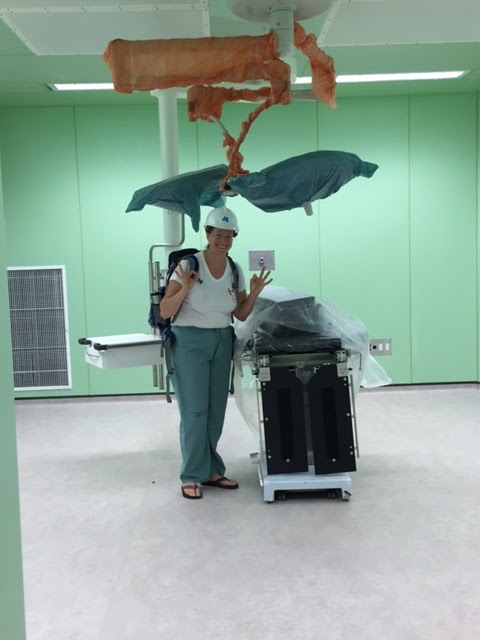
The labour floor has a dedicated holding area for anaesthesia and they have four available ORs for the labour floor. The doors are hermetically sealed with sliding doors, a digital clock with distinct red lights and a temperature monitor is placed at the top of the wall, similar to home. I think the ORs were even bigger than the ORs I use at home allowing the team members to easily move around.
Overall, the trip has been very insightful and rewarding. Areas I thought I would contribute to became disappointments. I would experience unexpected, rewarding surprises from observing the learners. I had an opportunity to see how my Masters could be applicable in the future as an education consultant, which was a new discovery for me. I am very happy I went and look forward to seeing where my new perspectives take me.